
Table of Contents
- What Actually is AMS?
- Can a Fit Person Get Altitude Sickness in the Himalayas?
- The Guide’s 4 Golden Himalayan Acclimatization Rules
- What is the Difference Between Normal Fatigue and AMS?
- Symptoms of Mountain Sickness
- HACE and HAPE Warning Signs
- Diamox for High Altitude Trekking: Magic Pill or Myth?
- The Ultimate Cure is Always Descending
- Frequently Asked Questions (FAQs)
The Truth About High Altitude: A Guide’s Honest Advice on Beating Mountain Sickness
24/07/2026
Almost every trekker I speak to asks the exact same question
before they even pack their bags. They want to know what happens if they get
sick in the mountains. It is the elephant on the trail. This fear looms much
larger in people's minds than the physical challenge of the hike itself.
Honestly, it is a perfectly valid concern. When looking up information on
altitude sickness Nepal trekking forums are filled with terrifying stories,
confusing medical jargon, and conflicting advice.
Having guided over thousand trekkers across the high passes
of Nepal, Bhutan, and Tibet over the last 12+ years, I have seen it all. I have
watched how the mountain affects different bodies. Here is the hard truth that
usually surprises people. Acute Mountain Sickness AMS does not care about your
fitness level. It does not care about your age, and it certainly does not care
how many marathons you have run back at sea level.
The good news is that this condition is entirely manageable.
If you respect the mountain, listen carefully to your body, and follow a few
non-negotiable rules on the trail, the elevation simply becomes part of the
adventure. You do not have to suffer to reach Base Camp.
What Actually is AMS?
Before we talk about how to prevent altitude sickness while
trekking in Nepal, we need to clear up the biggest misconception about it.
People often think there is simply less oxygen in the
mountains. Technically, the percentage of oxygen in the air at Everest Base Camp is exactly the same as it is at the beach. It sits right around 21
percent. The real culprit is barometric pressure. As you climb higher into the
Himalayas, the atmospheric pressure drops significantly. The air becomes
thinner, meaning the oxygen molecules are spread much further apart.
With every breath you take, you are pulling fewer oxygen
molecules into your lungs than you normally would. Imagine trying to breathe
through a narrow straw while walking up a long flight of stairs. Your body has
to work twice as hard to get the fuel it needs to power your muscles.
To compensate for the thinner air, your body needs time to
manufacture more red blood cells. These cells carry that limited oxygen more
efficiently throughout your system. That physiological process of adapting is
called acclimatization.
Usually, the human body handles this transition perfectly
fine up to about 2,500 meters or 8,200 feet. For context on the Everest BaseCamp trek, this is right around the time you face the massive, winding hill
leading up to Namche Bazaar. Above this specific threshold, if you hike up the
trail faster than your body can create those new red blood cells, you start
feeling the effects of the elevation.
Can a Fit Person Get Altitude Sickness in the Himalayas?
This is a question I hear on almost every single trip. The
short answer is yes. In fact, highly fit people often get sick faster than
average hikers.
Why does this happen? Fit people are used to pushing through
pain. They have great cardiovascular endurance, so they tend to walk very fast
on the lower sections of the trail. However, climbing a mountain is not a race.
When you push your heart rate too high, you demand more oxygen than the thin
air can provide. Meanwhile, the slower, older trekkers are taking their time.
They allow their bodies to slowly adjust to the changing pressure.
Fitness helps you carry your backpack, but it does
absolutely nothing to speed up how fast your blood adapts to low pressure.
Leave your competitive spirit at home.
The Guide’s 4 Golden Himalayan Acclimatization Rules
After more than a decade of leading expeditions, I have
developed a strict set of Himalayan acclimatization rules. These align
perfectly with the latest Wilderness Medical Society guidelines, but they are
tested on the actual dirt of the trail.
1.
The 300 to 500 Meter Rule for
Acclimatization
What is the 300 to 500 meter rule
for acclimatization? It is the absolute golden rule of high-altitude trekking.
Once you reach an elevation of 3,000 meters, you should never increase your
sleeping elevation by more than 300 to 500 meters in a single day.
Notice that I said "sleeping
elevation." You can hike up a massive 800-meter hill during the day, but
you must come back down to sleep. Furthermore, for every 1,000 meters of
elevation you gain, you must take a full rest day. We build these buffer days
into every single itinerary at Nepal Boundary Trekking Agency. If an agency
tries to sell you a rushed 10-day Everest Base Camp trek, run the other way.
They are playing a dangerous game with your health.
2.
The Climb High Sleep Low Method
This technique goes hand in hand
with the rule above. The climb high sleep low method is exactly what it sounds
like. On your designated rest days, you do not just sit in the teahouse.
Instead, we take a short hike to a higher elevation, spend an hour drinking
tea, and then walk back down to our lower camp to sleep.
For example, when we stay in Namche
Bazaar, we will hike up to the Everest View Hotel. The air is thinner up there,
which triggers your body to produce more red blood cells. Then, we drop back
down to Namche to sleep in richer, thicker air. This gives your body the stress
it needs to adapt, followed by the recovery environment it needs to rest.
3.
High Altitude Trekking Hydration
How much water to drink at high
altitude? You need to aim for a minimum of 3 to 4 liters every single day.
High altitude trekking hydration is
crucial because the mountain air is incredibly dry. Every time you exhale, you
lose moisture. Furthermore, as your body acclimatizes, you naturally breathe
heavier and urinate more frequently. Dehydration thickens your blood, making it
much harder for your heart to pump oxygen to your brain and muscles.
I always tell my clients to check
their urine. If it is clear, you are doing a great job. If it is dark yellow,
you need to stop and drink a full liter immediately. We strongly recommend
drinking plain water, green tea, or garlic soup.
4.
Ditch the Ego and Avoid Sedatives
The most dangerous thing you can
bring to the mountains is your ego. Hiding a headache from your guide is a
terrible idea. We are not going to force you down the mountain for a mild
headache, but we do need to monitor it.
Additionally, you must avoid
alcohol and sleeping pills entirely. Sleeping pills are respiratory
depressants. They slow down your breathing while you sleep, which is the exact
opposite of what your body needs to do to acclimatize. You might have weird dreams
or wake up frequently, but this is a normal part of the process.
What is the Difference Between Normal Fatigue and AMS?
When you walk uphill for six hours with a backpack, you are
going to feel tired. Your legs will ache, and you might get a mild headache
from the sun. This is completely normal fatigue.
So, how do you tell the difference? The key is how your body
responds to rest and hydration. If you arrive at the teahouse, drink a liter of
water, take a paracetamol, and your headache vanishes, you are just tired. If
the headache persists and feels like a severe hangover, you are moving into
dangerous territory.
Symptoms of Mountain Sickness
You must be honest with yourself and your guide about the
early symptoms of mountain sickness. They typically include:
- A
persistent, throbbing headache that painkillers do not fix.
- Nausea
or a complete loss of appetite.
- Dizziness
or feeling lightheaded when standing up.
- Extreme
fatigue that prevents you from eating or socializing.
If you have these symptoms, the rule is simple. Do not go up
until the symptoms go down. We will simply stay at our current elevation for an
extra night until your body catches up.
HACE and HAPE Warning Signs
If mild AMS is ignored and a trekker continues to ascend, it
can develop into two life-threatening conditions. High Altitude Cerebral Edema
HACE is swelling of the brain. High Altitude Pulmonary Edema HAPE is fluid in
the lungs.
The HACE and HAPE warning signs are absolute red flags.
- For
HACE: The trekker will lose coordination. They might walk like they
are drunk and struggle to walk in a straight line. They will also become
confused or irrational.
- For
HAPE: The trekker will experience extreme breathlessness even while
resting. You might hear a rattling sound in their chest, or they might
cough up pink, frothy sputum.
If a guide sees any of these signs, the trek stops
immediately. There is no waiting until morning. We organize a descent right
away, even in the middle of the night.
Diamox for High Altitude Trekking: Magic Pill or Myth?
Many trekkers ask me about using Diamox for high altitude
trekking. The generic name for this medication is Acetazolamide.
Diamox is not a magic cure, and it does not mask symptoms.
Instead, it is a preventative medication that artificially speeds up your
breathing rate, helping your body acclimatize faster. The standard dosage is
125 milligrams twice a day, starting 24 hours before you reach high altitude.
While it is highly effective, it does have side effects. You
will need to urinate frequently, and you will likely feel a strange tingling
sensation in your fingers and toes. I always recommend that my clients consult
their doctor back home before their trip. Diamox is an excellent tool, but it
never replaces the golden rules of gradual ascent and proper hydration.
The Ultimate Cure is Always Descending
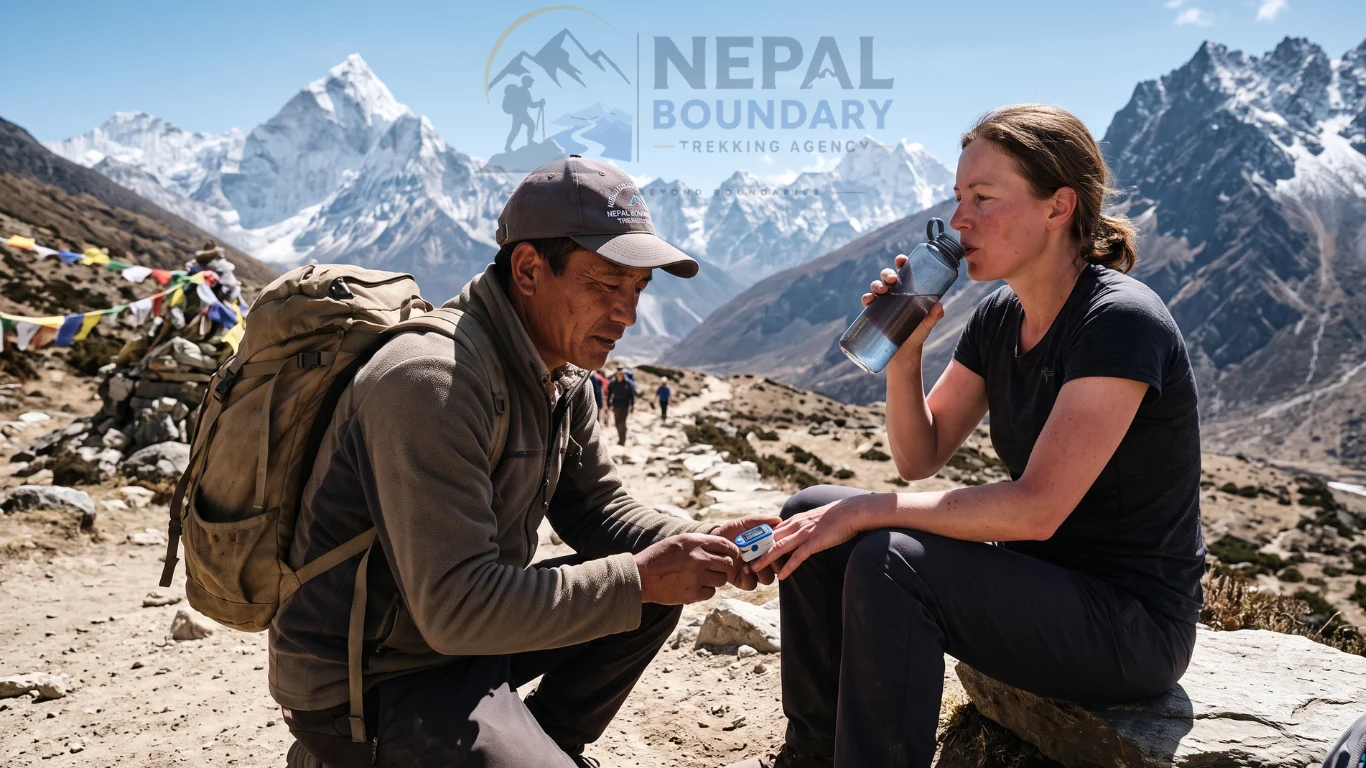
We carry oximeters to check your oxygen levels, our guides
are trained in advanced wilderness first aid, and we always carry comprehensive
medical kits. However, no medication in the world can replace the only true
cure for altitude sickness.
If your symptoms progress from mild to moderate, the
absolute best treatment is to descend. Dropping your elevation by just 300 to
500 meters provides almost instant relief. At Nepal Boundary Trekking Agency,
we never push our clients for the sake of a tight schedule. The mountain has
been there for millions of years, and it will be there next year.
The Himalayas are meant to be enjoyed, not merely survived. By choosing an itinerary with built-in acclimatization days, walking slowly, and communicating openly with your guide, you set yourself up for absolute success. The high passes are spectacular, and with the right pace, you will be able to take in every single view with a clear head and a strong body.
Frequently Asked Questions (FAQs)
Q: How to prevent altitude sickness while trekking in Nepal?
A: To prevent altitude sickness while trekking in Nepal, you must ascend slowly, stay hydrated by drinking 3 to 4 liters of water daily, and schedule regular acclimatization days. After a decade of guiding in the Himalayas, I always tell my clients that the secret is pacing. Walk at a very slow, conversational pace. Incorporate the "climb high, sleep low" strategy into your rest days, and avoid alcohol or sedatives completely. Your body simply needs time to adjust to the lower barometric pressure, so giving it that time is your best defense.
Q: What is the 300 to 500 meter rule for acclimatization?
A: The 300 to 500 meter rule states that once you cross an elevation of 3,000 meters, you must never increase your sleeping altitude by more than 300 to 500 meters per day. This rule is the absolute foundation of high-altitude safety. You can hike up a massive 800-meter hill during your day trip, but you must descend to sleep. Furthermore, for every 1,000 meters of total elevation gained, you must take a full day of rest. This structured timeline allows your blood to properly adapt to the changing environment.
Q: Can a fit person get altitude sickness in the Himalayas?
A: Yes, a highly fit person can easily get altitude sickness in the Himalayas, and they often fall sick faster than average hikers. Physical fitness gives you excellent muscle stamina, but it does absolutely nothing to speed up how fast your body creates new red blood cells. Very fit trekkers often make the mistake of walking too fast on the lower trails because they do not feel physically tired. This rapid ascent demands more oxygen than the thin air can provide, triggering AMS. The mountain demands patience from everyone, regardless of athletic ability.
Q: What is the difference between normal fatigue and AMS?
A: The main difference between normal trekking fatigue and Acute Mountain Sickness is how your body responds to rest and basic care. When you walk uphill for hours, your legs will ache and you might develop a mild headache from the intense sun. However, if you drink a liter of water, rest in the teahouse, and the headache goes away, you were just experiencing normal fatigue. If that headache turns into a severe, throbbing pain accompanied by nausea and dizziness that will not fade with rest, you are experiencing the early stages of AMS.
Q: How much water to drink at high altitude?
A: You need to drink a minimum of 3 to 4 liters of water every single day while trekking at high altitude. The Himalayan air is incredibly dry, and the higher you go, the faster you breathe. This means you exhale a massive amount of moisture without even realizing it. Dehydration thickens your blood, making it much harder for your heart to pump limited oxygen to your brain. I always advise my trekkers to monitor their hydration naturally. If your urine is clear, you are safe. If it is dark, you need to stop and drink immediately. Keeping your body hydrated and your pace slow is the best way to ensure your Himalayan journey is memorable for all the right reasons.